
Design of Learning Environments
Artifact One: Golden Texting Tips for the Golden Years (Basic iPhone Texting for Beginners)
Description: This design plan for free, asynchronous, self-paced instruction was the capstone project for IT 570. I collaborated with my partner to help senior citizens learn the basics of texting on an iPhone. Since the target learners would not necessarily have an iPhone for the training, we decided to use self-paced, asynchronous, online modules using an iPhone simulation made up of screencasts and screenshots of an actual iPhone
Rationale for Inclusion: This project posed unique challenges for assessing the learners while instilling knowledge about safety practices with texting. Therefore, aligning the performance and learning contexts required innovative thinking. The artifact demonstrates my ability to meet learner's needs with accessible training. It aligns well with AECT standards because it evidences my ability to adapt learning design to learning environments that fit the instructional needs.
AECT Standards:
-
Standard 1- Content Knowledge
-
Standard 2- Content Pedagogy
-
Standard 3- Learning Environments
-
Standard 4- Professional Knowledge and Skills
Collaboration Acknowledgement: This design plan was created in collaboration with Karianne MacPheron.
Artifact Two: Guest Service The Oakley Resorts' Way
Description: I collaborated with other students in IT 532 to design asynchronous training in guest service (customer service) for a fictitious hotel chain. The instruction involves learner-learner interaction and is housed in the employer's LMS.
Rationale for Inclusion: We designed this instruction with learner-learner interaction for deeper thinking. The hotel chain relied on their front desk personnel to quickly resolve any problems to their guest's satisfaction. The hotel brand is "Outstanding Guest Service." Boettcher and Conrad (2016) emphasized the need for different instructional methods for different learning outcomes. Since the group’s fictitious corporation relies on front desk agents to think on their feet to handle guest issues, more time interacting with the materials and reflecting on guest service scenarios leads to increased skill in the work setting. The learning activities were more complex to attain learning outcomes higher on Bloom's taxonomy. It aligns well with AECT standards because it evidences my ability to adapt learning design to the affordances of the learning environment.
Reference:
Boettcher, J. V., & Conrad, R.-M. (2016). The online teaching survival guide: Simple and practical pedagogical tips (2 ed.). San Francisco, CA: Jossey-Bass.
AECT Standards:
-
Standard 1- Content Knowledge
-
Standard 2- Content Pedagogy
-
Standard 3- Learning Environments
-
Standard 4- Professional Knowledge and Skills
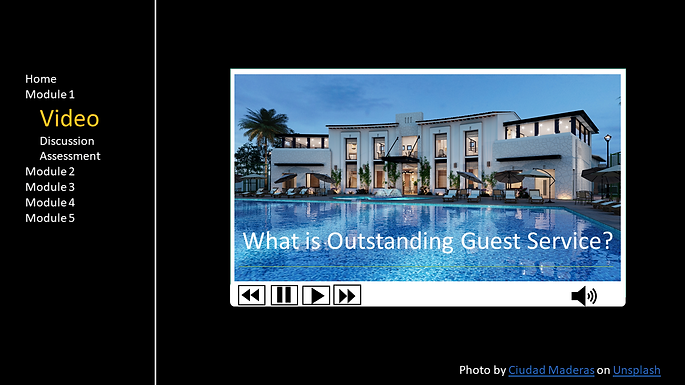
This graphic shows the video component of the learning activities for Module 1. This asynchronous component ensures consistency in onboarding employees despite differences in hire dates.

This mock-up of discussion board activity for Module 1 demonstrates another asynchronous component. While the video promotes consistency, the discussion board requires learner-learner interaction and encourages critical thinking.
Collaboration Acknowledgement: This design plan was created in collaboration with Damone Garner, Cindel Wyrick, and Amber Sewell. Note: I have updated the graphics for the project, but the substance remains the same.
Artifact Three: Participatory Online Activities Showcase Analysis
Description: I collaborated with other students in IT 573 to design for synchronous delivery of a module about Learning Analytics for a graduate-level course. The Analysis included is my own work. I identified areas for improving student engagement in future plans.
Rationale for Inclusion: This analysis demonstrates my flexibility in designing with constructivist principles for a graduate-level synchronous course. I developed authentic problems for the discussion board and break-out sessions and identified approaches to improve engagement in future designs. It aligns well with AECT standards because it conveys my ability to design for synchronous learning environments as well as asynchronous to facilitate learning and creating instructional designs based on learning principles .
AECT Standards:
-
Standard 1- Content Knowledge
-
Standard 2- Content Pedagogy
-
Standard 3- Learning Environments
-
Standard 4- Professional Knowledge and Skills

This graphic shows that the number of posts decreased in the second discussion board question of the week. This was partly due to a trend in the class for learners to post their original posts at the last minute. Because of the delay, their peers had less time to respond and spark an interactive discussion.